 中文
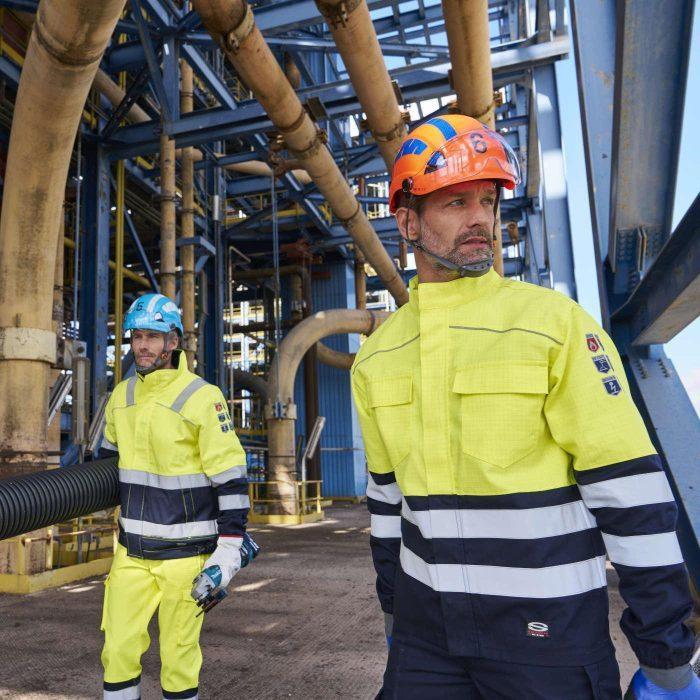
中文Basalt Fiber Protective Clothing Delivers Superior Flame and Chemical Resistance for Petroleum Industry Workers
Product Overview
Protective Clothing Solutions for the Petroleum Industry
Special protective clothing made from basalt fiber fabric is flame-resistant, high-
temperature resistant, and resistant to chemical corrosion, making it particularly
suitable for high-risk industries such as petrochemical and refining.
Performance advantages:
※ Flame retardant: With a limiting oxygen index (LOI) of over 70%, it does not ignite when exposed to fire and
self-extinguishes once the source of ignition is removed.
※ High temperature resistance: It remains undeformed and uncracked in a flame at 1100℃, offering strong protection
Protection Against Extreme
Environments
※ Chemical resistance: resistant to oil, acid, and alkali, suitable for harsh industrial environments.
Within petroleum refining, offshore extraction, and petrochemical manufacturing, personnel routinely operate adjacent to ignition sources, pressurized hydrocarbons, and elevated process temperatures. Conventional protective textiles frequently rely on topical flame-retardant chemistry that can degrade through laundering or abrasion, gradually compromising worker safety. Basalt fiber fabric supplies flame resistance as an intrinsic material property rather than a surface treatment, so the protective function is retained throughout the service life of the garment. This structural advantage is particularly valuable where operational continuity prevents frequent garment replacement and where failure of protective apparel carries severe consequences.
From a material-property perspective, basalt fiber is produced by melting quarried volcanic rock and extruding it into continuous filaments without added binders or resins. The resulting fabric is a single-ingredient textile whose protective character derives from the chemistry of the mineral itself. This simplifies hazard assessment, since no leaching additives or volatile finishing agents are present, and supports end-of-life considerations where reduced secondary pollution is preferred.
Technical Specifications
| Property | Performance (Basalt Fiber Fabric) |
|---|---|
| Flame retardant | With a limiting oxygen index (LOI) of over 70%, it does not ignite when exposed to fire and self-extinguishes once the source of ignition is removed. |
| High temperature resistance | It remains undeformed and uncracked in a flame at 1100℃, offering strong protection |
| Chemical resistance | resistant to oil, acid, and alkali, suitable for harsh industrial environments. |

Key Features & Advantages
• Flame retardant: With a limiting oxygen index (LOI) of over 70%, it does not ignite when exposed to fire and self-extinguishes once the source of ignition is removed.
• High temperature resistance: It remains undeformed and uncracked in a flame at 1100℃, offering strong protection
• Chemical resistance: resistant to oil, acid, and alkali, suitable for harsh industrial environments.
• Inherently flame-resistant mineral structure eliminates reliance on topical chemical finishes.
• Low smoke and non-toxic fume generation supports safer confined-space evacuation.
• Stable performance across repeated industrial laundering reduces total cost of ownership.
Application Scenarios
Protection Against Extreme
Environments
Basalt fiber protective clothing is well matched to extreme environments encountered during tank cleaning, furnace-area maintenance, catalyst handling, and emergency response within hydrocarbon facilities. The combination of flame resistance, high-temperature stability, and chemical inertness allows a single garment platform to serve multiple hazardous tasks, simplifying procurement and reducing the inventory of specialized suits. In confined or poorly ventilated spaces, the low generation of smoke and toxic combustion products further supports safer evacuation and respiratory protection. Field teams benefit from consistent performance across shift rotations, and safety managers gain a defensible specification backed by reproducible material behavior rather than variable coating quality.
Industry Value & Conclusion
For operators across the petroleum value chain, basalt fiber protective clothing represents a move toward durable, inherently safe personal protection. By embedding flame and chemical resistance within the fiber itself, operators reduce dependence on consumable treatments and lower lifecycle cost while raising the reliability of frontline safety equipment. The qualitative benefits—predictable behavior under fire, stability at extreme temperature, and resistance to aggressive media—translate directly into reduced incident severity and improved compliance with industrial safety programs. As refineries and petrochemical sites pursue higher safety standards, basalt-based protective textiles offer a credible, sustainable pathway to protect workers without sacrificing operational flexibility.